
A "town development agreement" with Tokyu Land Corporation in the greater Shibuya area, including the opening of a store at Shibuya Sakura Stage utilizing CCC's assets.
Shibuya Sakura Stage opened in 2024 with TSUTAYA BOOKSTORE, SHARE LOUNGE, re-search by CCC Art Lab, and Cheat Tokyo, showcasing CCC's diverse assets. (Updated Mar 21, 2025)
Upon opening the store, we signed a "town development agreement" with Tokyu Land Corporation, building a relationship that goes beyond simply being a tenant, and we are working hard to create systems to hold events and liven up the town.
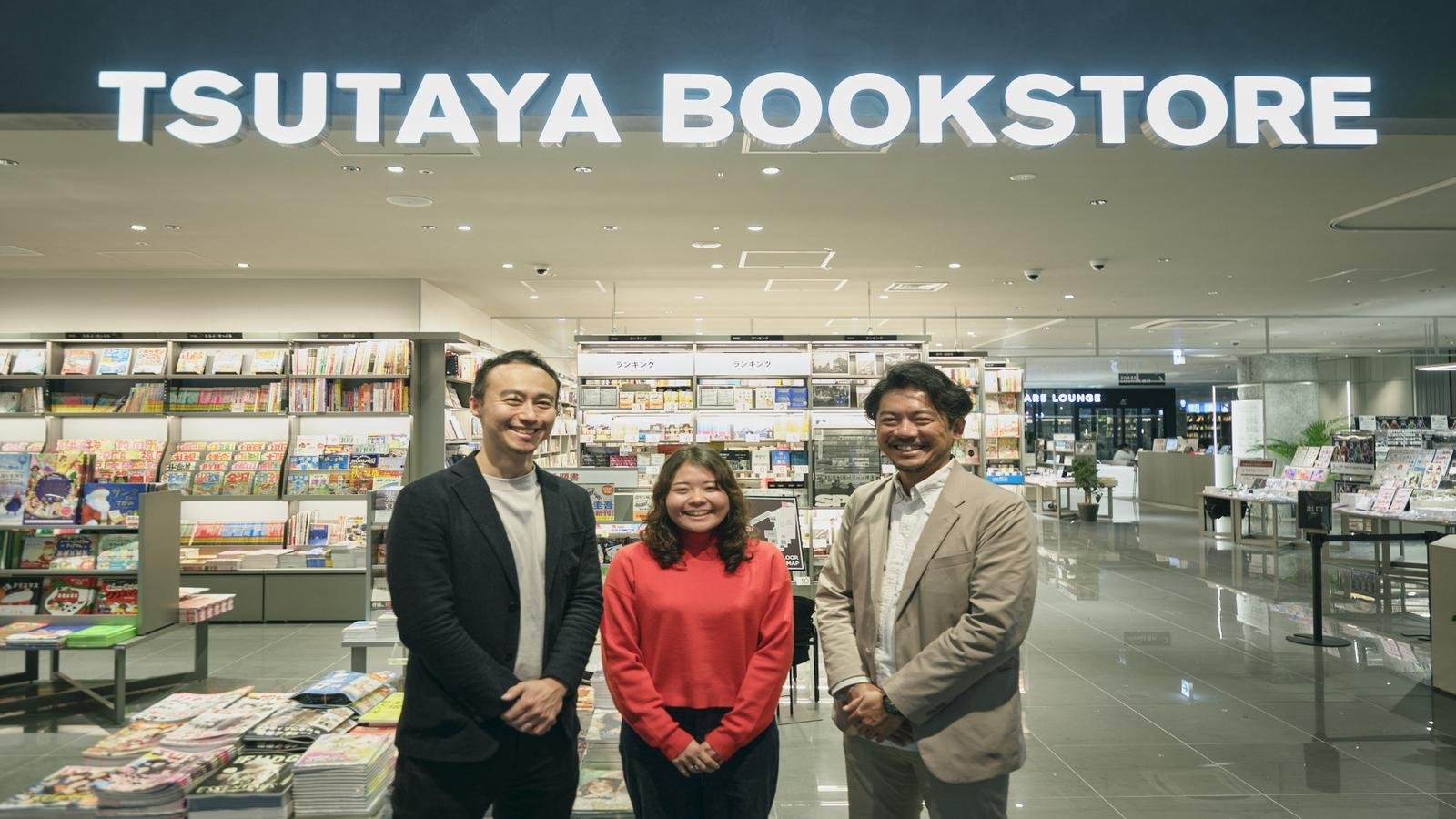
This time, we interviewed three people: Okubo Takashi of the Smart City Promotion Office, Urban Business Unit, Tokyu Land Corporation, who contacted CCC for the opening of Shibuya Sakura Stage; Harada Gon'ichiro of the Business Development Department, New Business Development Division, CCC; and Mizuno Saki of the Research & Planning Department, New Business Development Division, CCC.
-Please tell us about your role as you prepare to open the store.
Okubo: "At the time, my role was to be in charge of planning and tenant leasing for our commercial area in the new large-scale complex, Shibuya Sakura Stage. I was responsible for everything from deciding what kind of tenants to hire to conducting sales.
When the decision to open Shibuya Sakura Stage was made and we were in the early stages of developing the concept, we realized that we needed to think about a new type of commercial facility that was not an extension of what had come before, as we now live in an age where anything can be purchased online and lifestyle changes have accelerated since the COVID-19 pandemic. "

So we thought it would be a good idea to provide a place where people can make new discoveries, meet new people, and have fun, experiences that can only be had in the real world, and that can only be had in the real world. This is not something that can be done by the developer alone, and I believe that we need to think about it together with the tenants who will be moving into the commercial facilities, and work together to develop the city. Therefore, we decided to find tenants with whom we could build relationships that go beyond a traditional lease agreement, and then explore how we could work together to develop the town, and seek out this new type of partnership. This is the "urban development agreement" that we have concluded with CCC.
With this in mind, we looked for companies to become tenants who would be partners with us in livening up the town.

-What was the background that led you to contact CCC?
Okubo: There are fewer and fewer bookstores in the Shibuya area, so we wanted to include a book element in Shibuya Sakura Stage.
The Sakuragaoka area has always had a strong image as a "town of hobbies," and in the past there were many jazz cafes and live music venues, as well as a wide variety of shops, including niche bookstores, sports-related shops such as tennis and table tennis, and fishing tackle shops, despite being located in front of the station. I wanted to preserve these local characteristics and pass them on to future generations, and I thought that books could cover all genres. When it comes to proposing various lifestyles using books as a starting point, we thought that CCC was the perfect choice, so we contacted them.
When I saw stores such as Daikanyama T-SITE and Futako Tamagawa T-SITE Electrics, I felt that they were more than just bookstores, proposing lifestyle ideas using books as a starting point, and that they embodied exciting store spaces where people could make new discoveries, so I wanted them to open a store there and work together on developing the town.
Our ideal was to have a structure where tenants could connect with each other, rather than having each store be an independent commercial facility. It's similar to the "T-SITE" operated by CCC. "
-Please tell us how you came to work together on urban development.
Harada: "When a new commercial facility opens, we start by researching the people who live around Sakuragaoka through marketing research and questionnaire surveys using V POINT data to create a 'concept book' that outlines the commercial facility, describing what value it has, what it aims to achieve, the surrounding environment, and its target audience. From there, we were able to determine which genres we should focus on. "

Okubo: "Looking back, I realize that the marketing research we conducted during the development stage was necessary. Quantitative data is essential during development. Showing numbers is much more persuasive. "
Harada: "The areas that people in the Sakuragaoka area are most interested in are 'games,' 'food,' 'art,' 'music,' and 'sports.'Regarding "art," I thought it would be something we could work on together with CCC's Art Lab, and since we were opening a bookstore on the fourth floor, it would be interesting to collaborate with "games," which share the common theme of entertainment on the same floor. I also thought it would be good to do something with "food.""

Mizuno: Regarding "food," a person in charge at CCC MK HOLDINGS, with whom I had been in contact on a different matter, was working on food-related initiatives, so Okubo became interested and we began digging deeper to see if we could work together on something. We discussed how this could be developed as an initiative to connect with local areas, and we were also looking into holding events, so we thought it would be an interesting idea. "

-So with that background in mind, you started building stores and developing the town.
Mizuno: "Rather than just the department in charge being involved in the store opening, various members from within CCC participated in creating the store plan, which I think is a rare format for opening a store. Within the fairly established package of "TSUTAYA BOOKSTORE," we considered together which genres of books should be thicker, how to incorporate art into the store, and the facade...I think this project was created through collaboration between departments within CCC. "
-Now that you've seen the actual opening, how does it compare to what you originally envisioned?
Okubo: "I think it turned out exactly as I had originally envisioned. In addition to a bookstore that is strong at attracting customers, there is also an attractive food hall, an event space centered around games, and a well-equipped food sales area on the second floor that can be used by workers and residents in the area. Additionally, we wanted to incorporate some variety, like an event, into the area around the escalator in the center of the facility, and we were able to achieve that as well. On the fourth floor, an exhibition space called "re-search" was created by CCC Art Lab, which allowed us to incorporate an "art" element. "

Mizuno: "Our team is not usually one to get so deeply involved in store opening plans, but this time we started with marketing research and were able to be involved in the products that are replaced daily, and then we were able to see the current situation after the store actually opened and customers came in - it's quite a rare case. "
Harada: Regarding "art," I think there are some "new things" that can only be realized by forming a framework to create something together with Tokyu Land Corporation, rather than CCC opening a store. Even now, six months after opening, we hold regular meetings and continue to work together to create the sales floor. "
Okubo: "That was the ideal format from the beginning. I wanted the tenants who set up shop in the food hall, as well as the food retail tenants, to not just open and be done with it, but to get together after opening and discuss what fun things they should do next, like a friendly neighborhood association. Rather than the developer being at the center and saying things like, "This is what the next event will be like," I wanted to create an environment where everyone could bring their own ideas and discuss them, in order to liven up the facility and, by extension, the town.
We hope to see more events in the future that connect tenants, such as an art event held in collaboration with CCC Art Lab's exhibition space "re-search" and the adjacent game creator hub "404 Not Found.""

-What are your expectations for CCC in the future?
Okubo: "That's right. Tokyu Real Estate is primarily a company that creates spaces. CCC has books as its content, and various other things such as music and art are connected to this as its core. And as it changes with the times, I think it keeps up with the trends. That's why I would be happy if we could continue to work together to create interesting proposals that are tailored to the characteristics of each venue. I think the appeal of CCC is its "comprehensive strength" that allows it to expand into any form, with books as its core. "

Harada: "Certainly, CCC has been operating bookstores for some time, but for the first time, we are releasing a new package for "Food" called "Cheat Tokyo."There is still much that needs to be done, but our store-building know-how, experience, and content matched well with the space that Tokyu Real Estate has, resulting in a single project that I believe has created new value for CCC. We are currently working on several new projects with Tokyu Real Estate, and we look forward to continuing to take on various challenges together. "
