
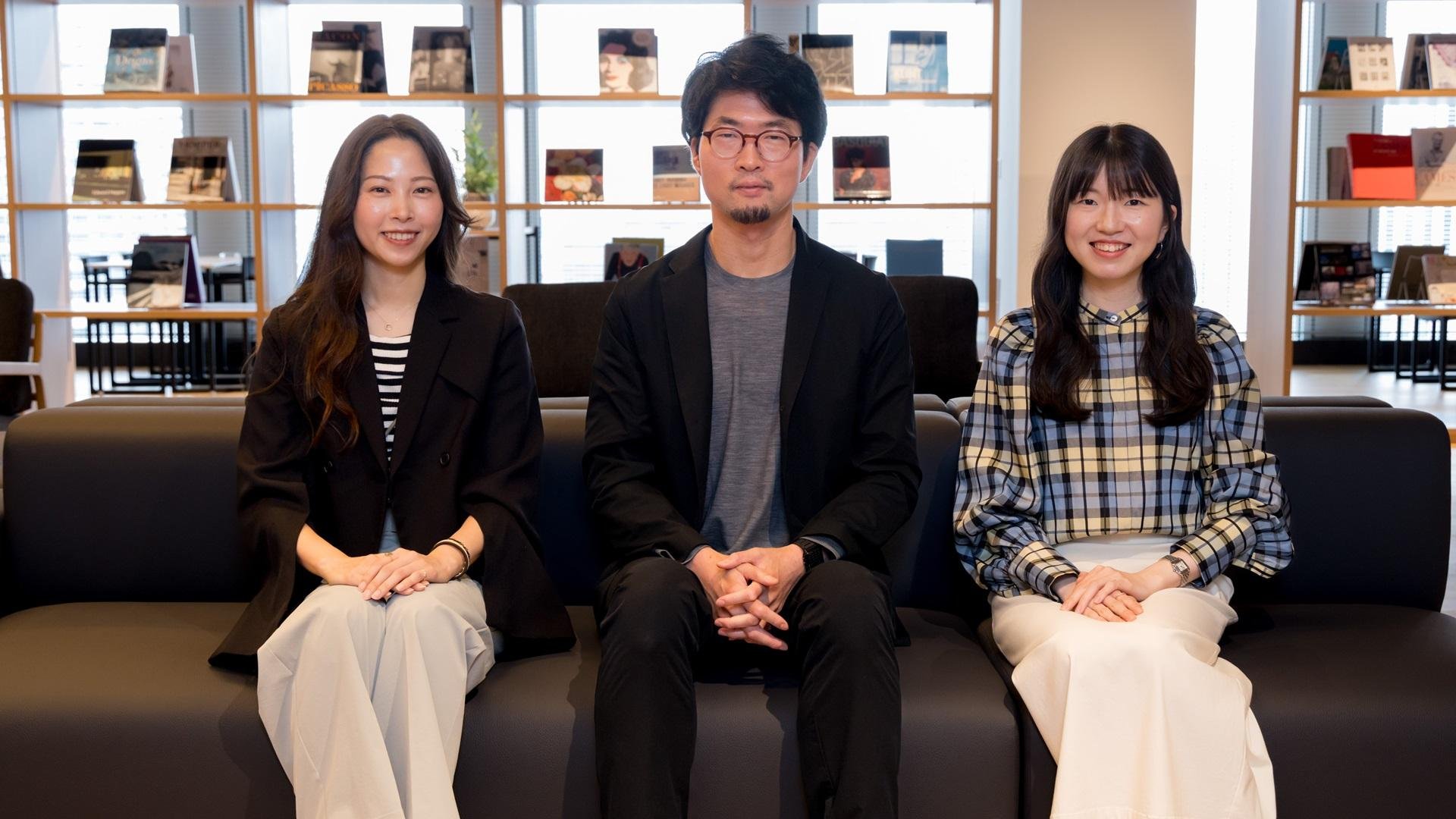
Designing ways of working: A new office challenge based on the idea of "ABW"
Adapting offices to work styles, CCC Group moved its HQ from Shibuya, Tokyo to Minato Mirai, Yokohama in May 2025. The new office reflects employee insights and company culture, designed collaboratively by internal teams.
Why did we need a new office now?
Kimura: Up until now, CCC has been working to create an environment where each employee can work autonomously, based on the concept of "career autonomy," which is our human resources strategy. We offer flexible working styles that are not bound by time or place, such as remote work from home or using the SHARE LOUNGE, encouraging side jobs, and flexible working hours.
Against this backdrop, the company decided to relocate its office as a management decision, marking the milestone of approximately 10 years since it established its office in Shibuya. By integrating the three previously separate floors and separate locations into one large floor, we aim to create an office space that will realize the working styles of the future.
This project was not just a relocation, but was launched with the aim of "redefining the working environment 10 years from now."The project members wanted to focus on young employees who will lead the way in future work styles, so we were approached and began an initiative to consider from scratch what kind of office would be suitable for new work styles, rather than just continuing on the same path as before.

How ABW (Activity Based Working) was applied to the space
Kimura: In this project, we are introducing the concept of "ABW (Activity Based Working)" throughout the office. This is a work style that allows each employee to choose where to work depending on the work content and mood of that day and time.
We have redefined the role of the office as "a place where innovation and planning come about, and where internal and external communication and collaboration naturally occur."In an era where workplaces are becoming more diverse, we felt it was important to design a place that would make people want to come to work. The keyword "CCC PARK" was born as a spatial concept that symbolizes this redefinition. This is an image of an open and creative space where anyone can visit freely, like a park, choose how to spend their time, and make unexpected connections and discoveries.
In the new office, employees can flexibly use different areas depending on their daily tasks and mood. For example, if you want to concentrate in a quiet place, you can use a private partitioned booth, if you want to brainstorm ideas or have a meeting with multiple people, you can use an open table, and if you want to relax, you can use an area with a panoramic view of Minato Mirai's scenery and art.The space itself offers options for how you work.
We believe that we were able to create such a space thanks to the leadership of our in-house design team, which has the knowledge gained from designing Tsutaya Bookstore and SHARE LOUNGE. Because the team is involved in designing spaces on a daily basis, they were able to gain a deep understanding of "what functions employees truly need" and create a flexible, highly refined design.
To make it a usable space. The significance of being handled by CCC designers
Fujishita: The CCC Group has an in-house design team that has worked on spatial design for Tsutaya Bookstore, SHARE LOUNGE, hotels, residences, and more. For this office project, we decided to have in-house designers take charge of the design rather than outsourcing.

Kimura: Having an in-house team meant that planning and design could work together very smoothly, and a major benefit was that we were able to share intentions and nuances at a detailed level. For example, the concept of "CCC PARK" - a "park-like space" - was something that was quickly adopted as a common understanding based on intuitive keywords, a strength unique to our company.
Watanabe: We worked closely with the planning team that defined the requirements, carefully listening to the opinions of the company and reflecting them in the space. We visited the site many times and checked the layout with masking tape, designing every detail with a sense of the site. From the overall vision design to layout, material selection, and furniture prototyping, the in-house team took the lead. We worked with trusted external partners to coordinate with the facility and handle the application process, ensuring both feasibility and creativity.

A design that embodies the essence of CCC
Watanabe: When designing the office, we focused on incorporating the "habits" and culture of our employees into the design. For example, CCC employees tend to be "talkative" and "loud" (laughs). For this reason, we needed a quiet area where people could concentrate, and we doubled the number of conference rooms to accommodate the high-communication environment.
Additionally, the work desks are 1200mm wide, the same width as those in the SHARE LOUNGE. We aimed to create a space where you can concentrate while maintaining a comfortable distance, without being bothered by the person next to you. Furthermore, careful consideration has been given to the design, such as preventing eye contact with people across from you and arranging plants in conjunction with the adjustable panels.
Fujishita: We also paid particular attention to the layout, which allows for easy navigation. The design allows employees to move around the office without any partitions on each floor, which encourages natural communication, such as casual conversations in the hallways or chance encounters near relaxation areas. From the warmth of the external business meeting area, which makes extensive use of wood, to the open refreshment space and the tranquil quiet space. In addition to the design, we have also devised ways to design traffic flow and create clear lines of sight that "naturally encourage people to take action."We will introduce it with actual photos.


The thoughts behind the design
Fujishita: We have experience creating a wide variety of spaces, including stores, libraries, hotels, and residences. We also provide services that cater to people's lifestyles, such as book selection and art. By utilizing this knowledge, we were able to pursue not only design but also elements such as "comfort" and "authenticity."I think this approach of viewing space as an "experience" rather than simply a function was put to good use in this office. In the future, we would like to expand the perspective on space creation that we have accumulated to proposals and projects in a wider range of areas.
Watanabe: I feel that our experience with office relocations makes our spatial designs more persuasive to our clients. CCC has the strength to design spaces, services, and content in an integrated manner. Another strength of our design team is our sensitivity to people's senses, such as how they perceive brightness and their personal habits. We will continue to create value from a spatial approach and strive to give back to society and our customers more widely.

Hitomi Kimura
After working in public works, he became involved in the beauty business and Tsutaya Bookstore. He currently works in the Marketing Strategy Department at Tsutaya Bookstore Headquarters, where he supports the entire business through cross-sectional numerical management and analysis. He was a key member of the project for this office relocation, leading the entire process from planning to progress management.
Tomohiko Fujishita
After studying architecture at university, he worked at an interior and architectural design firm before joining CCC. Currently, as a designer, he designs a wide range of spaces, including offices, stores both in Japan and overseas, and hotels. In this project, he played a central role in the planning and design.
Ema Watanabe
He studied spatial and blueprint design at the Faculty of Design, and joined CCC after working at Tsutaya Bookstore. After joining the company, he was in charge of sales promotion and store opening strategies, and was responsible for planning and zoning in store development. He then moved to the design department and is currently mainly involved in store standardization work.